Thursday, April 22, 2021

Celebrate the end of the school semester with soft, flaky, no-yeast pretzels!

Whether you are a K-12 student, college student, teacher, parent, or work in the education system, celebrate the end of the semester, and National Pretzel Day on Monday April 26th, by preparing a fun treat for yourself, Danish inspired Pretzels, found in Around the World Making Cookies, by Josephine Perry, 1940, TX771.P4 1940.

This semester we are featuring recipes from cookbooks located in the UW-Stout Archives Special Collections. The Special Collections are older, more rare, or Stout related books that were originally located in the UW-Stout Library’s main stacks collection. This past year we added a wealth of cookbooks to the special collections, and I scoured the shelves for recipes to bring the world of baking to your home during this time.

Recipe Card


Before trying this recipe, I found many variations of pretzel recipes, and modified my original recipe to include steps from other recipes. Variations include using or not using yeast, the types of ingredients in the pretzels, dipping the pretzels into a pot of hot water and baking soda before baking them, spreading a beaten egg wash onto pretzels before baking (which I added to my recipe), sprinkling with salt or sugar, spreading butter on the pretzels after they are baked, adding cheese to the mix, and the list goes on. If I make them again, I will probably roll the dough into longer strips to make bigger pretzels. This first time, I kept my dough strips flat after cutting them. The pretzels came out soft and flaky, with a light, crispy bottom. They taste like biscuits. As I am from Wisconsin, I love dipping a soft, salty pretzel into a bowl of hot cheese sauce. Pretzels are also good sprinkled with cinnamon and sugar. If you are subscribed to the Discovery Plus platform, I suggest checking out the Magnolia Table cooking show hosted by Joanna Gaines. She has an episode all about appetizers, and creates yeast-based pretzels and a cheese dipping sauce that looks amazing! Bon Appetit!

Ingredients: Flour, Sugar, Baking powder, Butter, Heavy whipping cream

The mixed dough

Pretzel set up with rolling pin station and egg wash


If folding pretzels seems like a daunting task, here are a couple Youtube tutorial videos to help get you started: 

https://www.wikihow.com/Twist-a-Pretzel

https://www.youtube.com/watch?v=XCtGEkl6Ljs 

https://www.youtube.com/watch?v=ILXH7kxtcxw


Similar pretzel recipes without yeast:

Brianna Joycee: https://briannajoycee.wordpress.com/2012/09/06/soft-homemade-pretzels-without-yeast/

The Beader Chef: https://www.thebeaderchef.com/no-yeast-pretzels/

The Gunny Sack: https://www.thegunnysack.com/two-ingredient-dough-pretzel-bites/


By: Julie Hatfield, Archives Assistant, UW-Stout Archives

Thursday, April 8, 2021

Happy National Library Week and Chinese Almond Cookie/Almond Cake Day!

This semester we are featuring recipes from cookbooks located in the UW-Stout Archives Special Collections. The Special Collections are older, more rare, or Stout related books that were originally located in the UW-Stout Library’s main stacks collection. This past year we added a wealth of cookbooks to the special collections, and I scoured the shelves for recipes to bring the world of baking to your home during this time.

End National Library week on a high note by curling up with a good book and a treat this weekend, Chinese Almond Cakes, found in Around the World Making Cookies, by Josephine Perry, 1940, TX771.P4 1940.

Chinese Almond Cake recipe card


If you are looking for a good book recommendation, or want to learn more about UW-Stout’s 125+ year history, I suggest An Idea Comes of Age: UW-Stout, 1891-2016, by Jerry Poling. We have them available to sell in the archives!: https://secure.touchnet.com/C21720_ustores/web/product_detail.jsp?PRODUCTID=2128&SINGLESTORE=true

An Idea Comes of Age book


Archives Assistant Julie Hatfield at book signing, 2017 UW-Stout Family Weekend

When I was originally picking out recipes to try baking this semester, I did not realize that this recipe for Chinese Almond Cakes is very similar to the previous recipe I tried of Almond Short Bread. They both had a crumbly texture after being mixed together, and I needed to add water and mix the dough with my hands to make it stick together to shape into cookies. I did substitute the rice flour for regular flour and cornstarch, or you could also use cake flour for baking. Rice flour and cornstarch are both used as thickeners in recipes. So I used 1 cup white flour, but took out 2 tablespoons flour and added 2 tablespoons cornstarch, and sift together. I rolled out 1 ½ dozen cookies with this recipe. They turned out nice and soft. If you can find rice flour at your local grocery store, I suggest trying to use it. Bon Appetit!


Recipe Ingredients: flour, cornstarch, brown sugar, butter, ground almonds 

Cookies ready to go in the oven

Cookies hot out of the oven


Some variations of Chinese Almond Cookie recipes:

Table for Two by Julie Chiou: https://www.tablefortwoblog.com/chinese-new-year-almond-cookies/

Taste of Home: https://www.tasteofhome.com/recipes/chinese-almond-cookies/

The Woks of Life: https://thewoksoflife.com/almond-cookies-chinese/

By: Julie Hatfield, Archives Assistant, UW-Stout Archives


Wednesday, March 17, 2021

Happy St. Patrick's Day and National Irish Food Day with Almond Short Bread Cookies

Happy St. Patrick's Day and National Irish Food Day! This semester we are featuring recipes from cookbooks located in the UW-Stout Archives Special Collections. The Special Collections are older, more rare, or Stout related books that were originally located in the UW-Stout Library’s main stacks collection. This past year we added a wealth of cookbooks to the special collections, and I scoured the shelves for recipes to bring the world of baking to your home during this time.

Get into the Irish spirit with an easy 5-ingredient cookie recipe, Almond Short Bread, found in Around the World Making Cookies, by Josephine Perry, 1940, TX771.P4 1940.

Almond Short Bread, p. 98

Mix together:

2 cups flour sifted

½ cup almonds blanched and ground

½ cup butter softened

½ cup sugar

1 tbsp. water

Add the sugar and flour alternately to the butter, blending in the water as needed to make a stiff dough. Divide into halves, form into flat round cakes about the size of a saucer, prick with a fork, flute the edges and bake at 350*F for 30 minutes.

This is a short, 5-ingredient recipe, but I still had some issues, probably because the directions are so simplified. Mixing one cup flour and the butter together started well and it had a dough like mixture, but as I added more sugar and flour the mixture became more dry and crumbly. I added almost two extra tablespoons of water. The recipe does not specify where to add in the almonds, so I added them at the end after mixing the other ingredients together. When dividing the dough into halves, other Almond Short Bread cookie recipes call for wrapping the two halves in plastic wrap and putting them in the fridge for one hour. You could use a round cookie cutter to cut the cookies (which I should have done, but I thought it would be hard with the crumbly texture of my dough), or roll the dough into two logs and cut into slices for baking the cookies. This recipe said to make them about the size of a saucer, like a small plate placed under a teacup, so I made my round cakes bigger than a regular sized cookie, and made three cakes. They still turned out good in the end, they just need to be broken up to eat them. They taste similar to the Ischl Tartlet cookies I made in February. They are a little on the dry side, but would be good spread with raspberry jam or dunked in your morning cup of coffee. No matter how often we bake and cook, we are continuously learning new ideas, skills, and recipes, so don't be discouraged if something doesn't turn out perfect the first time you try it. Learn from your experience and try again, or apply your new skills to another recipe. I also try to find a silver lining, such as being able to dunk my slightly dry cookies into my morning coffee for a breakfast treat. Bon Appetit!

My 5 ingredients: sugar, flour, water, butter, ground almonds

The mixes dough

My attempt to shape the short bread from my dry dough


Almond Short Bread hot out of the oven


There are many variations of shortbread cookies. Try Almond-Orange Shortbread from Martha Stewart: https://www.marthastewart.com/340976/almond-orange-shortbread

And a Gluten free Almond Flour Shortbread Cookie:  https://www.theconsciousplantkitchen.com/almond-flour-shortbread-cookies/

By: Julie Hatfield, Archives Assistant, UW-Stout Archives


Thursday, March 4, 2021

Opa! Let's make baklava this weekend

This semester we are featuring recipes from cookbooks located in the UW-Stout Archives Special Collections. The Special Collections are older, more rare, or Stout related books that were originally located in the UW-Stout Library’s main stacks collection. This past year we added a wealth of cookbooks to the special collections, and I scoured the shelves for recipes to bring the world of baking to your home during this time.

Recipes: Middle Eastern Cooking, 1976 cookbook


Let’s travel to Greece to create multi-layered Baklava, via Recipes: Middle Eastern Cooking, Foods of the World, Time-Life Books, TX725.M628N52 1976. We have a variety of the Food of the World cookbooks that feature recipes from a certain country or region. Discover more information about these cookbooks here: https://en.wikipedia.org/wiki/Foods_of_the_World

I had the chance to travel to Italy and Greece over the 2007-2008 New Year’s Holiday as part of the UW-Eau Claire Blugold Marching Band. We traveled for 10 days and performed in Rome and Florence, Italy, and Athens, Greece. It was a great experience and besides trying new foods, such as gelato and baklava, and touring the cities, my favorite part was performing in St. Peter’s Square for the Pope on New Year’s Day.  


Julie on top of Hotel Stanley, with Parthenon in background


Blugold Marching Band performing in Athens, Greece


Olympic Stadium in Athens, Greece


Greek Islands

Baklava (Layered Pastry with Walnuts and Honey Syrup), p. 98

To make one 9 x 13 inch pastry

¾ lb. butter, cut into ¼ in. bits

½ cup vegetable oil

40 sheets filo pastry, each about 16 in. long and 12 in. wide

4 cups shelled walnuts pulverized in a blender, nut grinder, or mortar and pestle

Clarify the butter in a heavy saucepan or skillet: Melt the butter slowly over low heat without letting it brown, skimming off the foam as it rises to the surface. Remove the pan from the heat, let it rest for 2 or 3 minutes, then spoon off the clear butter and discard the milky solids at the bottom of the pan.

Preheat the oven to 350* and stir the vegetable oil into the clarified butter. Using a pastry brush coat the bottom and sides of a 13 x 9 x 2 ½ in. baking dish with about 1 tbsp. of the mixture.

Fold a sheet of filo in half crosswise, lift it up gently and unfold it into the prepared dish. Press the pastry flat, fold down the excess around the sides and flatten it against the bottom. Brush the entire surface of the pastry lightly with the butter and oil mixture, and lay another sheet of filo on top, folding it down and buttering it in similar fashion. Sprinkle the pastry evenly with about 3 tbsp. of walnuts. Repeat to make 19 layers total. Spread the 2 remaining sheets of filo on top and brush the baklava with the rest of the remaining butter and oil mixture.

With a small, sharp knife score the top of the pastry with parallel diagonal lines about ½ inch deep and 2 inches apart, then cross them diagonally to form diamond shapes. Bake in the middle of the oven for 30 minutes. Reduce the heat to 300* and bake for 45 minutes longer, or until the top is crisp and golden brown.

SYRUP

1 ½ cups sugar

¾ cup water

1 tbsp. fresh lemon juice

1 tbsp. honey

While baklava is baking, make the syrup. Combine the sugar, water and lemon juice in a small saucepan and, stirring constantly, cook over moderate heat until the sugar dissolves. Increase the heat to high and, timing it from the moment the syrup boils, cook briskly, uncovered, for about 5 minutes, or until the syrup reaches a temperature of 220* on a candy thermometer. Remove pan from heat and stir in honey. Pour syrup into a bowl or pitcher and set aside.

When the baklava is done baking, remove from oven and pour syrup over it. Cool to room temperature and cut into diamond shaped pieces to serve.


If this venture seems daunting, like it did to me at first, here is a tutorial video to help you get started: https://www.youtube.com/watch?v=ewjl_ZJ8onk

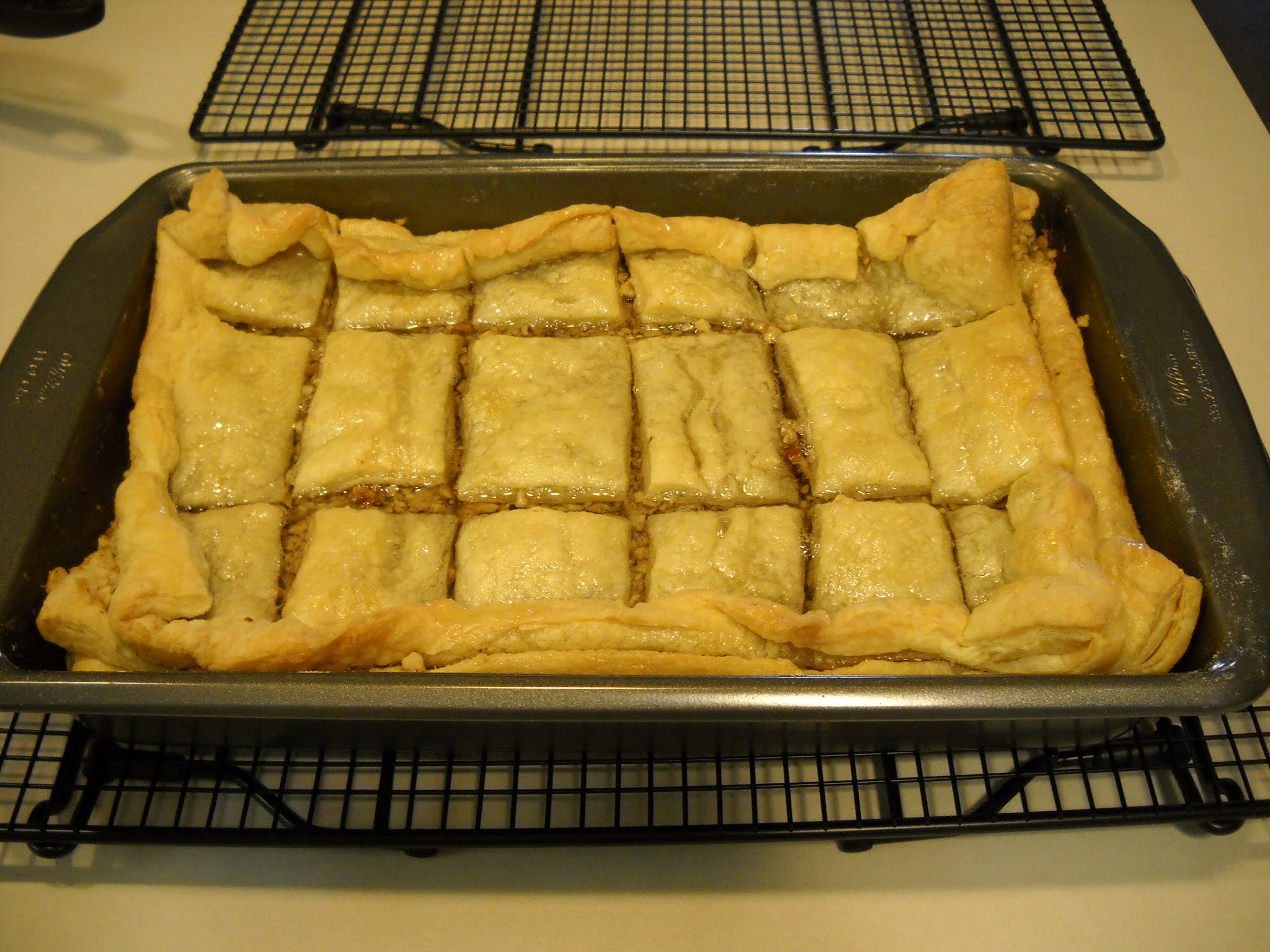
I have seen different variations of ingredients used for baklava, but the process for preparing it is essentially the same. This recipe calls for melting 3 sticks of butter and combining vegetable oil to it, which I think is extra work than is necessary. I have seen recipes where they just melt butter or spray cooking spray for in between the filo sheet layers. My butter did not have foam rise to the surface as it melted, it just melted. My butter and oil mixture got thick as it cooled, while I was assembling the layers. This recipe only has walnuts for the filling, but other recipes use seasonings, chocolate spread, hazelnuts and pistachios with the walnuts. I did not find filo pastry sheets at the grocery store, so I used four puff pastry sheets to layer, which are thicker, but worked just as well. It was in the oven about 15 minutes less than the recipe said (probably because of using puff pastry sheets, and my oven was preheating for a long time). I suggest using a large vs. a small saucepan to boil the syrup. My syrup boiled over and made a big, sticky mess on my stovetop. The baklava does taste good, with a sweet, nutty flavor. It tastes like I remember from Greece, but I ate one with chocolate filling before. Baklava is messy to make, so prepare for clean-up duty! Bon Appetit!


Baklava ingredients

Chopping the walnuts - I started with my Magic Bullet and moved to my Pampered Chef chopper

Melting butter to brush on the pastry layers

Prepping work area for pastry layer assembly

Assembled and cut layers before baking in the oven

Baklava out of the oven with syrup poured on top


By: Julie Hatfield, Archives Assistant, UW-Stout Archives

Wednesday, February 17, 2021

Fun with Jam! Bake Ischl Tartlets this weekend

This semester we are featuring recipes from cookbooks located in the UW-Stout Archives Special Collections. The Special Collections are older, more rare, or Stout related books that were originally located in the UW-Stout Library’s main stacks collection. This past year we added a wealth of cookbooks to the special collections, and I scoured the shelves for recipes to bring the world of baking to your home during this time.

Recipes: The Cooking of Vienna's Empire, 1968, cookbook


Our next stop is Vienna to bake Ischl Tartlet cookies, via Recipes: The Cooking of Vienna’s Empire, Foods of the World, Time-Life Books, New York, TX721.W42 1968. We have a variety of the Food of the World cookbooks that feature recipes from a certain country or region. Discover more information about these cookbooks here: https://en.wikipedia.org/wiki/Foods_of_the_World


Ischl Tartlets (To make 12 Tartlets), p. 93

½ lb. + 4 tbsp. unsalted butter, softened (2 ½ quarter lb. sticks)

2/3 cup sugar

2 cups sifted all-purpose flour

1 ¾ cups ground almonds

1/8 tsp. cinnamon

5 tbsp. raspberry jam

Confectioner’s sugar

Cream the butter and sugar together by beating them against the side of a bowl with a wooden spoon or by using an electric mixer at medium speed, until the mixture is light and fluffy. Beat in flour (½ cup at a time), the almonds and cinnamon, and continue beating until the mixture becomes a slightly stiff dough. Shape the dough into a ball, wrap it in wax paper or plastic wrap and refrigerate it for about an hour.

Preheat the oven to 325*. On a lightly floured surface, roll the dough into a sheet 1/8 in. thick. With a 2 ½ inch circle cookie cutter, cut as many circles from the sheet as you can. Roll and knead dough until you make 12 circles. Arrange on ungreased baking sheet. Repeat the rolling and cutting process to make 12 more circles, and cut out the center of each circle with a ½ in. cookie cutter. Bake both batches in the center of the oven for 10-15 minutes, or until light brown.

Place cookies on a wire rack to cool, about 20 minutes. Spread the tops of the solid circles with a thin coating of jam; lay a cutout cookie on top of each, and press together to make a sandwich. Spoon a dab of jam into the opening of each tart and sprinkle with confectioner’s sugar.


This recipe was not too hard to follow, just a little on the messy side to mix the dough and spread the jam on the cookies. I do not make cookies often, so it was fun to use my cookie cutters. I made these right before Valentine’s Day, so I also cut out heart shaped cookies and spread jam in between two heart shaped cookies. These cookies are also good without jam spread on top. I say have fun with the cookie shapes, jam flavor, and variations of using jam or no jam. These cookies are delicious, especially with your morning cup of coffee, and my family approved! As the character Joey from the TV show Friends says, “Jam…good!” Happy Baking!

Cookie ingredients

The mixed dough, ready to go in the fridge

Rolling and cutting the cookies

Cookies on baking sheets, ready to go in the oven

Cookies fresh out of the oven, cooling on paper towels and newspaper lining

The finished cookies, perfect for any holiday or weekend fun!


Try a different variation of this cookie, from pillsbury.com:

https://www.pillsbury.com/recipes/austrian-ischl-tartlets/81461a86-480a-440d-99af-8289c3c41c80

By: Julie Hatfield, Archives Assistant, UW-Stout Archives

Thursday, February 11, 2021

Celebrate National Italian Food Day with Sicilian Cake

This semester we are featuring recipes from cookbooks located in the UW-Stout Archives Special Collections. The Special Collections are older, more rare, or Stout related books that were originally located in the UW-Stout Library’s main stacks collection. This past year we added a wealth of cookbooks to the special collections, and I scoured the shelves for recipes to bring the world of baking to your home during this time.

Recipes: The Cooking of Italy, 1972, cookbook


Our first stop is Italy to create Sicilian Cake with Chocolate Frosting, via Recipes: The Cooking of Italy, Foods of the World, Time-Life Books, New York, TX723.R552 1972.  We have a variety of the Food of the World cookbooks that feature recipes from a certain country or region. Discover more information about these cookbooks here: https://en.wikipedia.org/wiki/Foods_of_the_World

I had the chance to travel to Italy and Greece over the 2007-2008 New Year’s Holiday as part of the UW-Eau Claire Blugold Marching Band. We traveled for 10 days and performed in Rome and Florence, Italy, and Athens, Greece. It was a great experience and besides trying new foods, such as gelato and baklava, and touring the cities, my favorite part was performing in St. Peter’s Square for the Pope on New Year’s Day.   

Julie, in front of the Roman Forum

UW-EC Blugold Marching Band, St. Peter's Square, New Year's Day 2008

Florence, Italy


Sicilian Cake with Chocolate Frosting (to serve 8), p. 94

A fresh pound cake about 9 in. long and 3 in. wide

1 lb ricotta cheese

2 Tbsp. heavy cream

¼ cup sugar

3 Tbsp. Strega (an orange-flavored liqueur)

3 Tbsp. coarsely chopped mixed candied fruit

2 oz. semisweet chocolate, coarsely chopped

With a sharp, serrated knife, slice the end crusts off the pound cake and level the top if it is rounded. Cut the cake horizontally into 1/2 to ¾ in. thick slabs. Rub the ricotta through a coarse sieve into a bowl with a wooden spoon and beat it with a rotary or electric beater until smooth. Beating constantly, add the cream, sugar and Strega. With a rubber spatula, fold in the chopped candied fruit and chocolate. Center the bottom slab of the cake on a flat plate and spread it generously with the ricotta mixture. Carefully place another slab of cake on top, keeping the sides and ends even, and spread with more ricotta. Repeat until all the cake slabs are reassembled and the filling has been used up-ending with a plain slice of cake on top. Gently press the load together to make it as compact as possible. Do not worry if it feels wobbly; chilling firms the loaf. Refrigerate the cassata for about 2 hours, or until the ricotta is firm.


CHOCOLATE FROSTING

12 oz. semisweet chocolate, cut in small pieces

¾ cup strong black coffee

½ lb. unsalted butter, cut into ½ in. pieces and chilled (2 sticks butter)

Melt 12 oz. of chocolate with the coffee in a small heavy saucepan over low heat, stirring constantly until the chocolate has completely dissolved. Remove the pan from the heat and beat in the chilled butter, 1 piece at a time. Continue beating until the mixture is smooth. Then chill this frosting until it thickens to spreading consistency. With a small metal spatula, spread the frosting evenly over the top, sides and ends of the cassata, swirling it as decoratively as you can. Cover loosely with plastic wrap, wax paper or aluminum foil and the let the cassata “ripen” in the refrigerator for at least 24 hours before serving it.


This recipe might seem intimidating at first – it did to me – but I took a few shortcuts that will hopefully help you. I used a frozen Sara Lee pound cake that I thawed ahead of time, which worked really well to slice and spread the ricotta mixture on. I did not find ricotta cheese at the grocery store, but substituted cottage cheese. This was my first time trying cottage cheese, and I was not crazy about it, so I suggest using ricotta cheese if you can find it. I also did not rub my cottage cheese through a course sieve, which would probably make it taste better. My cottage cheese mixture was a little on the soupy side, but it spread well on the pound cake layers, which I cut four layers. I replaced the Italian Strega (an orange flavored liqueur with strong notes of mint, juniper, and saffron) with mint extract. For the mixed candied fruit I used Sweetened Dried Sliced Kiwi. My fruit options at the store were either dried fruit or 2 different containers used for fruit cake filling. When recipes call for chopped semi-sweet chocolate, I tend to use baking chips instead, even though they might have different melting consistencies, but I find it easier to buy bags of chips. The chocolate frosting is pretty straight forward to make. I took the sticks of butter right out of the fridge and cut them, the smaller, the better for mixing. The end product resembles a Yule Log Cake. I should have researched ahead of time on ricotta cheese substitutes, and tried cream cheese instead of cottage cheese. I recommend following the recipe as is and don’t try my substitutes. I was not crazy about the overall taste of the cake. But trial and error is how you learn and become a better baker. Also, if you have left-over heavy whipping cream, to add 2 tablespoons of powdered sugar and whip it into whip cream to top off your piece of cake. I use my Pampered Chef whipped cream maker to easily whip up cream: https://www.pamperedchef.com/shop/Gifts/Holiday/Whipped+Cream+Maker/1461  Bon Appetit!

Sicilian Cake and Chocolate Frosting ingredients

Mixing together cottage cheese, chocolate and dried fruit

Slicing the pound cake

Spreading the cottage cheese mixture on pound cake layers

Pound cake reassembled

Cutting the butter to mix in the chocolate frosting

The Chocolate frosting mixed together

The finished cake, set in front of a bag I bought in Rome


By: Julie Hatfield, Archives Assistant, UW-Stout Archives


Friday, December 11, 2020

Stress-free study break snacks that won't break the bank

This school year we are featuring recipes from cookbooks located in the UW-Stout Archives Special Collections. The Special Collections are older, more rare, or Stout related books that were originally located in the UW-Stout Library’s main stacks collection. This past year we added a wealth of cookbooks to the special collections, and I scoured the shelves to find new recipes to try that would make cooking from home fun, affordable, and easy.


Calling all Blue Devils! Create some easy and delicious end-of-semester study break snacks from the Better Homes and Gardens Microwave Cookbook, 1976, TX832 .M47 1976. This cookbook provides tips and tricks for cooking and baking time saving recipes with your microwave. Most recipes use just the microwave, or a combo of the microwave, oven, or stovetop. Learning to cook a variety of recipes with a microwave can be a useful skill, especially if you are a college student without ready access to a stovetop or oven. You can still find this cookbook on Amazon: https://www.amazon.com/Better-Homes-Gardens-Microwave-Cook/dp/0696010356

Look for more fun recipes and cooking tips on the Better Homes and Gardens website: https://www.bhg.com/recipes/


Spiced Honeyed Cider, p. 15

In a 4-cup glass measure cup mix 3 cups apple cider or apple juice, 1 tbsp. honey, ¼ tsp. ground cinnamon, and 1/8 tsp. ground nutmeg. Micro-cook, uncovered, till hot, about 6-7 minutes. Serve in mugs. Dot with butter. Makes 4 (6 ounce) servings.


Scotch Crunchies, p. 51

1 6-ounce package butterscotch pieces (1 cup)

1 6-ounce package semi-sweet chocolate pieces or imitation

1 3-ounce can chow mien noodles

1 cup tiny marshmallows or raisins

In large glass bowl place butterscotch and chocolate pieces. Micro-cook, uncovered, till melted, about 2 ½ minutes; stir after each minute. Stir in noodles and marshmallows or raisins. Drop by teaspoon onto waxed paper. Chill, if desired. Makes about 3 dozen.


The spiced honeyed cider and scotch crunchies are just the ticket to warm you up and give you the energy boost you need to keep studying for end-of-semester exams. You can use a variety of ingredients, and cut in half or double batch, to create your own version of these treats. For the cider, I used Pepin Heights apple cider. Instead of separate cinnamon and nutmeg, I used about 1 tsp. Cinnamon Plus spice blend, by Pampered Chef, which includes a variety of spices mixed together, perfect for baking, apple treats, hot drinks, and more. I did not dot my cider with butter. I think you could use as little or as much for spices as you want, and keep or omit the honey, depending on your taste preferences.  

Cider ingredients: Apple Cider, Cinnamon Plus spice blend, honey


For the scotch crunchies, I used a ½ bag of butter scotch chips, a ½ bag of semi-sweet chocolate chips, 1 cup mini-marshmallows, and 1 cup straight pretzels, which I broke in half. I could not find chow mien noodles at the grocery store.  After melting and mixing the ingredients together, I used a muffin scooper to scoop onto a baking sheet layered with parchment paper. This recipe is similar to the “Haystacks” recipe by Betty Crocker. With this recipe, I think you could make as little or as much as you want, and use any combination of sweet and salty treats you like to mix together, such as cereal, Teddy Grahams, or candy, like M&M's. These treats would pair great with the Cheddar Cheesy popcorn recipe we posted last week. Bon Appetit!  

Scotch Crunchie ingredients: marshmallows, chips, pretzels


Lining up the ingredients


Mixing the ingredients and getting ready to scoop onto parchment paper


The finished scotch crunchies


The scotch crunchies pair well with a steaming cup of apple cider!


If you want to try a similar recipe to Scotch Crunchies, but using the stovetop, check out Stout’s Favorites cookbook, 1955, via the Internet Archive:

Unbaked Oatmeal Drop Cookies, p. 26: https://archive.org/details/StoutsFavoritesFirstEdition/page/n27/mode/2up

Try Betty Crocker’s White Chocolate Haystacks, using the microwave, from bettycrocker.com: https://www.bettycrocker.com/recipes/white-chocolate-haystacks/d3e902da-efba-4bc6-a669-bed1742f6152

By: Julie Hatfield, Archives Assistant, UW-Stout Archives